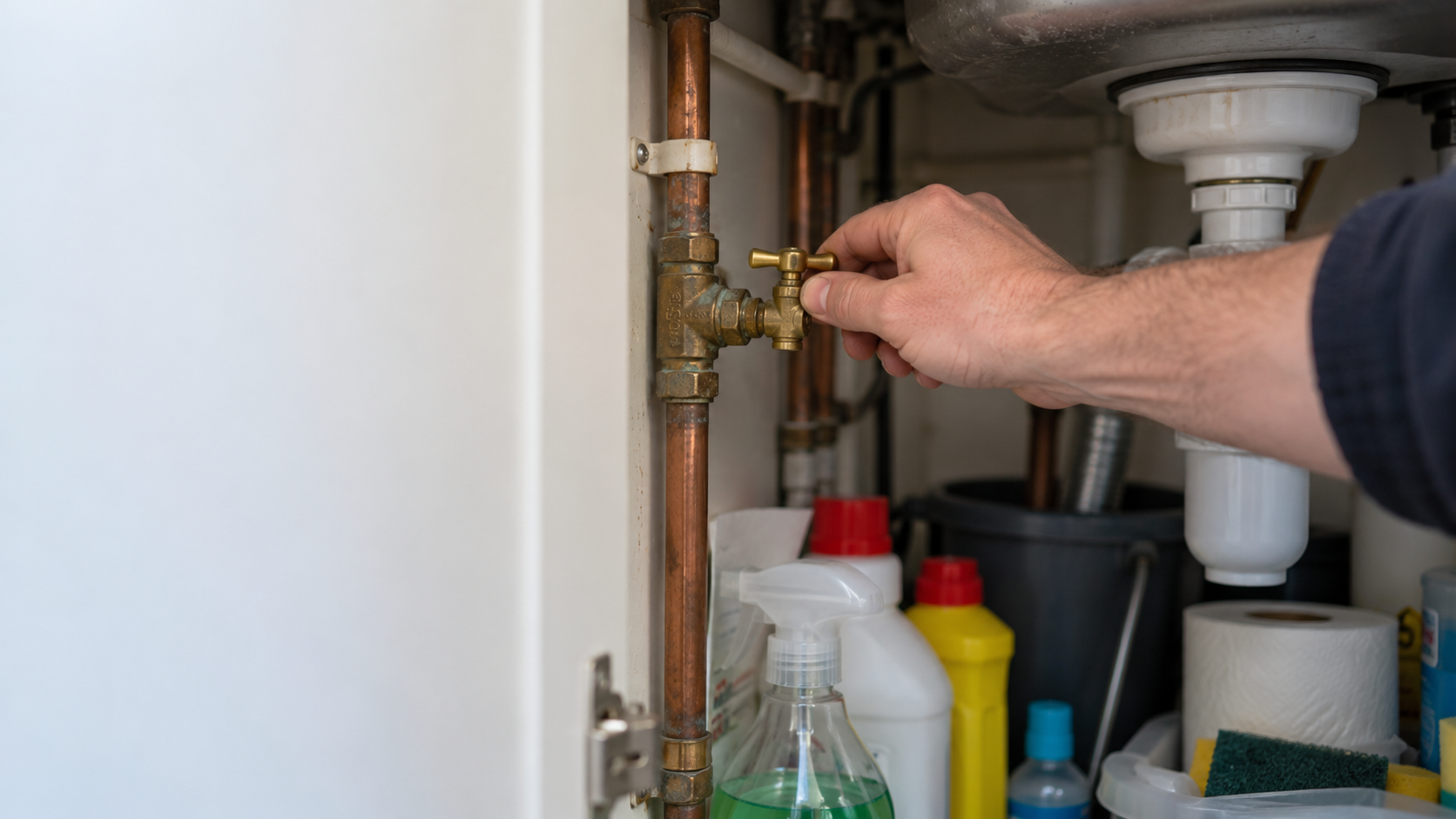
Your stopcock is the valve that turns off the water supply to your whole home. In most houses, it’s under the kitchen sink, on the pipe where the mains water comes in. To turn it off, turn it clockwise until it stops. Finding it now, before you have a leak, could save you a lot of water damage later.
Why your stopcock matters
If a pipe bursts or a tank overflows, water can come through ceilings and soak floors within minutes. Turning off the stopcock stops more water flowing in while you wait for a plumber. It’s also needed for simple jobs like changing a tap or fixing a toilet that won’t stop running.
The trouble is, many people only go looking for it in an emergency, when every second counts.
Where to find your stopcock
Start by looking where the mains water pipe comes into your home. The most common places are:
- Under the kitchen sink. This is where it is in most homes, often at the back of the cupboard.
- Under the stairs, particularly in older terraced properties.
- Near the front door or under the floorboards just inside it.
- In a downstairs toilet, utility room or airing cupboard.
- In the garage, in some newer homes.
If you live in a flat, it may be in a cupboard in the hallway or, in some blocks, in a communal area. Your landlord or building manager should be able to tell you.
A stopcock usually looks like a small brass tap with a round handle, or a lever on the pipe. Newer homes sometimes have a lever valve, which you turn a quarter turn so the lever sits across the pipe.
What about the outside stopcock?
There’s usually another stopcock under a small metal or plastic cover in the pavement or front garden. This one normally belongs to the water company and controls the supply to your property. You shouldn’t need to use it, and in an emergency the inside stopcock is quicker and easier to reach.
How to turn off your stopcock
- Turn the handle clockwise until it won’t go any further. If it’s a lever valve, turn it a quarter turn.
- Run the cold tap in the kitchen to check the water has stopped.
- Open your other taps to drain the water left in the pipes, if you’re dealing with a leak.
- If water is near electrics, switch off the electricity at the fuse box.
To turn the water back on, turn the stopcock anticlockwise slowly, then check for drips around the valve.
What if my stopcock is stuck?
Stopcocks that haven’t been touched for years often seize up. Don’t force it with tools, as an old valve can snap and make a leak much worse. Try gently turning it back and forth a little at a time. If it still won’t move, call us, and in an emergency the water company can turn off the supply at the outside stopcock.
A simple check worth doing twice a year
Turn your stopcock off and back on again every six months or so. This stops it seizing and means you’ll know it works when you need it. While you’re there, make sure the cupboard isn’t so packed that you can’t reach it in a hurry, and show everyone in your home where it is.
If your stopcock is stiff, leaking or hard to reach, our engineers can replace it or move it somewhere easier to get to. It’s a small job that gives real peace of mind.
Leak or burst pipe right now?
Turn off the stopcock, then call us. Our team handles emergency plumbing across Birmingham and Solihull, from burst pipes to overflowing tanks, and our leak trace and repair service can find hidden leaks behind walls and under floors.
MS HEATING AND PLUMBING has been looking after homes for over 29 years. We’re a Which? Trusted Trader and Age UK Birmingham approved, so you can trust us in your home.